


The subtle design shift that's separating premium brands from everyone else in 2026
You have 50 milliseconds to make an impression online.
Not 5 seconds. Not "a few moments." Fifty. Milliseconds.
That's faster than you can read this sentence. And in that micro-moment, your website is either pulling someone in or quietly letting them bounce to your competitor's site.
So here's the question nobody's asking but everyone should be: Is your website just sitting there... or is it actually working?
Because here's what I'm seeing as we head into 2026—there's a massive gap forming between websites that feel alive and websites that feel like digital brochures. And the difference? Motion design.
But not the kind you're thinking of.
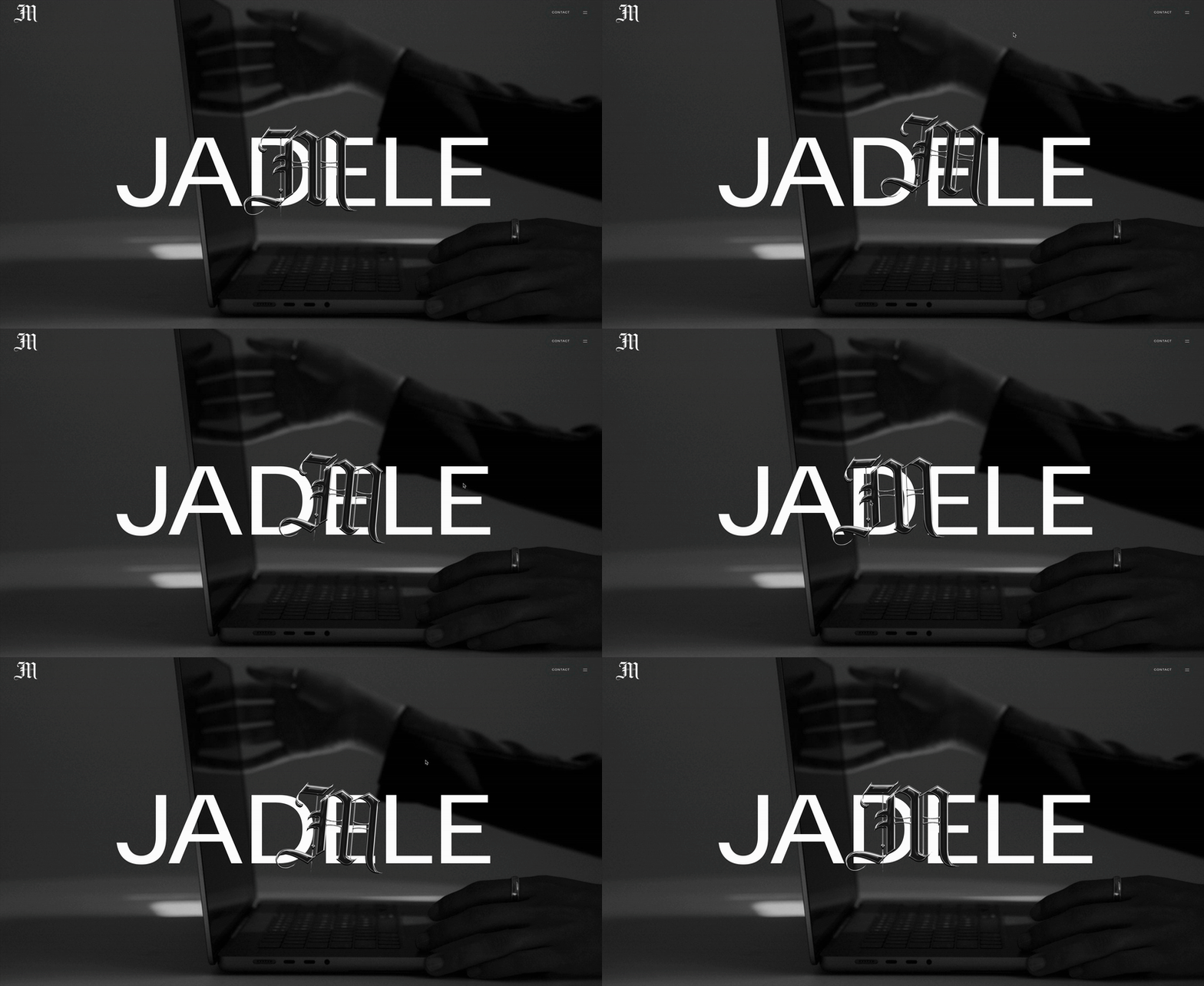
Motion Isn't Eye Candy Anymore. It's Infrastructure.
Let me be clear: I'm not talking about those obnoxious spinning logos or text that flies in from seventeen different directions making you feel like you're watching a PowerPoint from 2003.
I'm talking about intentional motion. The kind that guides your user's eye exactly where it needs to go. The kind that builds trust before someone even reads your copy. The kind that makes your site feel premium without saying a word.
Studies actually prove this (yes, real studies—not just designer opinions). Animations help users identify patterns faster. They reduce cognitive load. They make decisions easier.
Think about it: When a button subtly shifts on hover, you know it's clickable. When a section smoothly reveals itself as you scroll, you feel guided through the story. When transitions flow instead of jump, your brain relaxes because it understands what's happening.
That's not decoration. That's user experience infrastructure.
"But Won't Animations Slow Down My Site?"
Five years ago this was a valid concern. Animations used to mean chunky GIF files or massive video backgrounds that made your site load like it was running on dial-up.
But that's dead now.
Welcome to 2026, where we have Lottie animations—JSON-based files that are under 1MB, infinitely scalable without getting pixelated, and actually support interactivity. There's even something called dotLottie that's EVEN SMALLER.
Translation: You don't have to choose between a beautiful site and a fast site anymore.
You can have smooth, sophisticated motion design AND lightning-fast load times. The technology finally caught up to what designers have been trying to do for years.
The AI Problem Nobody's Talking About
Okay, real talk for a second.
AI is everywhere right now. And yes, it's helpful—I'm not going to pretend it's not. AI can generate layouts, suggest color palettes, even write your meta descriptions.
But here's what AI absolutely cannot do: feel.
AI doesn't understand that a screen transition should feel confident for a law firm but playful for a kids' brand. It doesn't know that an empty state on your pricing page might make someone anxious, so the animation needs to be reassuring, not flashy. It can't tell you that your hero section feels "off" because the timing is 200 milliseconds too slow.
Those decisions? They require empathy. Brand context. Human judgment.
And THAT is your competitive advantage heading into 2026.
Because here's what's about to happen: The internet is about to be flooded with AI-generated websites that all look... fine. Competent. Serviceable. They'll check the boxes. They'll have all the right sections.
But they'll all feel the same.
The brands that stand out will be the ones that feel human. The ones where someone clearly made intentional decisions about how every element moves, responds, and guides the user's experience.
.gif)
So What Does This Mean For You?
If you're an established expert—someone who's impressive in person, who's built real credibility, who's invested in coaches and courses and showing up—your website needs to match that energy.
Not with flashy gimmicks. Not with every trend thrown at the wall. But with strategic motion design that makes people feel something when they land on your site.
The kind of design that makes someone think: "Oh. They're different."
Because motion design isn't about making things move for the sake of movement. It's about creating an experience that feels premium, intentional, and unmistakably YOU.
And no AI prompt is going to figure that out.
Welcome to 2026.
Where your website either moves with purpose, or it gets left behind.
Where fast AND beautiful isn't a trade-off anymore.
And where the brands that win are the ones that understand: good design isn't about following formulas. It's about making people feel something.
Your online presence should work as hard as you do. And in 2026, that means it needs to move.
XX, Jenn
